Background: Candida auris (C. auris) is an emerging multidrug-resistant fungal pathogen linked to multiple healthcare-associated outbreaks in the United States. Combined treatment and containment costs typically range from $40,000 to $100,000 per case. C. auris colonizes multiple anatomical sites - including the gastrointestinal (GI) tract - and persists for days to weeks on environmental surfaces, even under routine disinfection protocols. These properties render conventional infection prevention and control (IPC) approaches insufficient. Fecal incontinence (FI) is highly prevalent in critically ill and non-ambulatory patients and creates a continuous, high-bioburden vehicle for GI shedding, environmental contamination, and onward C. auris transmission.
Methods: Narrative review of contemporary peer-reviewed literature, U.S. Centers for Disease Control and Prevention (CDC) surveillance data, and published cost analyses addressing C. auris epidemiology, environmental persistence, GI colonization, and the role of FI containment in pathogen control. Searches were conducted in PubMed and CDC publications. Closed-loop automated stool management (ASM) was evaluated as a candidate component of multimodal IPC bundles.
Results: Reported U.S. C. auris clinical cases rose by 95% between 2020 and 2021, and 4,514 new clinical cases were reported in 2023. A multicenter U.S. analysis of 192 hospitalizations (2017-2022) reported a 34% crude mortality rate, with 20% of cases representing bloodstream infections (47% mortality). More than 90% of clinical isolates demonstrate fluconazole resistance, and emergent echinocandin resistance has been documented. FI affects approximately 19 million U.S. adults and is reported in 33-40% of intensive care unit patients and 20-46% of long-term acute care residents; conventional management - adult diapers, absorbent pads, and indwelling balloon catheters (IBCs) - exhibits leakage rates of 40-78% and consumes 174-348 minutes of nursing time per patient per day. The Qoramatic Automated Stool Management system, a closed-loop device using low-grade intermittent negative-pressure suction with automated irrigation, achieved 100% successful fecal diversion with a 1.8% leakage rate in pivotal evaluation, reduced daily nursing time to approximately 6.8 minutes (initial) and 0.4 minutes (follow-up), and eliminated mucosal pressure-related injury.
Conclusion: FI is an underappreciated but mechanistically important driver of C. auris environmental contamination and cross-transmission. Conventional FI management offers only partial, leakage-prone containment that sustains environmental bioburden. Closed-loop automated stool diversion may represent a practical, clinically safe, and operationally effective intervention to interrupt transmission pathways and merits consideration as a fundamental component of multimodal IPC bundles in high-acuity and long-term care settings where C. auris burden is greatest.
Candida auris, Fecal incontinence, Multidrug-resistant organism, Infection prevention, Closed-loop stool management, Environmental contamination, Hospital-acquired infection, Automated stool management
ASM: Automated Stool Management; BSI: Bloodstream Infection; C. auris, Candida auris; CDC, U.S. Centers for Disease Control and Prevention; CVC: Central Venous Catheter; FI: Fecal Incontinence; GI: Gastrointestinal; HAI: Healthcare-Associated Infection; HAPI: Hospital-Acquired Pressure Injury; IAD: Incontinence-Associated Dermatitis; IBC: Indwelling Balloon Catheter; ICU: Intensive Care Unit; IFU: Instructions For Use; IPC: Infection Prevention and Control; LTAC / LTACH: Long-Term Acute Care (hospital); MDR: Multidrug-Resistant; PPE: Personal Protective Equipment; SAP: Super-Absorbent Polymer.
Since its first description in 2009, Candida auris has emerged as a multidrug-resistant yeast posing a distinct and expanding threat in healthcare settings worldwide [1]. The U.S. Centers for Disease Control and Prevention (CDC) reports that 4,514 new clinical cases of C. auris were identified in 2023 [2], indicating persistent and widespread transmission across acute and long-term care facilities and a rapidly expanding U.S. clinical burden.
Unlike many Candida species, C. auris readily colonizes patient skin [1] and persists for prolonged periods on environmental surfaces, sustaining outbreaks. Its capacity for resistance is well documented: more than 90% of clinical isolates demonstrate resistance to fluconazole [3]. and emergent echinocandin resistance has been reported in U.S. clusters [3].
Crude mortality among hospitalized C. auris infections is substantial. A U.S. analysis of 192 hospitalizations between 2017 and 2022 reported 34% crude mortality, with 20% of cases representing bloodstream infections and 47% mortality among bloodstream cases [4].
Although skin colonization (e.g., axilla, groin) has been the primary surveillance focus, gastrointestinal (GI) tract involvement is increasingly recognized as a significant — though underappreciated — reservoir. Fecal incontinence (FI), particularly common in critically ill and non-ambulatory patients, represents a clinically important vehicle for C. auris dissemination. Uncontrolled fecal effluent deposits organisms onto bedding, patient surroundings, and shared surfaces [1,5], prolonging environmental contamination and increasing the likelihood of transmission via healthcare-worker contact.
Cross-contamination risk persists because conventional FI management — absorbent pads, adult diapers, and inconsistent bedpan use — does not reliably contain stool or reduce bioburden [6]. These limitations underscore the need for more effective, proactive containment strategies.
Advanced fecal management technologies, particularly closed-loop automated stool management (ASM) systems, present a promising approach. By actively diverting fecal effluent through low-grade intermittent negative-pressure suction, these devices minimize leakage and reduce both staff and environmental exposure. As such, they may represent essential components of infection prevention and control (IPC) frameworks aimed at containing the spread of multidrug-resistant organisms such as C. auris in high-acuity care settings.
This narrative review synthesizes contemporary peer-reviewed literature, U.S. CDC surveillance data, and published cost analyses addressing C. auris epidemiology, GI colonization, environmental persistence, and the role of FI containment in healthcare-associated transmission. PubMed and CDC publications were searched in 2024-2025 using combinations of the terms Candida auris, fecal incontinence, gastrointestinal colonization, automated stool management, infection prevention, environmental contamination, and multidrug resistance. Reference lists of identified articles were screened to surface additional sources. Closed-loop ASM was evaluated as a candidate component of multimodal IPC bundles, with attention to leakage performance, nursing-time impact, and economic implications.
Candida auris has rapidly become one of the most significant multidrug-resistant fungal pathogens facing contemporary healthcare since its discovery in 2009 [1].
Its spread has been both global and unusually rapid. In the United States between 2020 and 2021, reported clinical cases rose by 95% [7], reflecting not only ongoing growth but accelerating transmission across care settings.
High-acuity environments — including intensive care units (ICUs), acute care hospitals, and units serving immunocompromised or device-dependent patients — represent the epicenter of this burden. In these populations, C. auris causes severe invasive disease (bloodstream, urinary, and wound infections) with high mortality. A major factor enabling spread is its capacity to colonize multiple body sites; while axillary and groin colonization are well described, rectal and GI involvement are increasingly recognized [8], leading many surveillance programs to incorporate rectal swabs or stool specimens to detect asymptomatic carriers.
Environmental persistence further amplifies risk. C. auris can survive on patient-zone surfaces for days to weeks even under routine cleaning regimens and tolerates many commonly used disinfectants [5]. This resilience enables sustained environmental contamination, repeated seeding events, and ongoing transmission. High-touch care, prolonged hospital stays, device use (lines, tubes, drains), and frequent staff-patient interactions create optimal conditions for propagation once the organism is introduced.
Clinical, operational, and financial implications follow. Outbreak management typically requires elevated isolation, intensified environmental disinfection, increased surveillance testing, cohorting strategies, staff training, and the diversion of dedicated personnel. Per-case care and containment costs frequently reach $40,000-$100,000. Rising antifungal resistance — including resistance to multiple therapeutic classes — narrows the available treatment options and complicates clinical management.
The CDC has classified C. auris as an urgent public health threat owing to its rapid spread, environmental persistence, high mortality in susceptible populations, and capacity to disseminate even under stringent infection-control measures [9]. These trends underscore the need for more robust surveillance frameworks and proactive containment strategies to reduce environmental bioburden and stop transmission within U.S. healthcare facilities.
Fecal incontinence — the involuntary passage of stool — is a frequent and clinically significant complication among critically ill and high-acuity populations. Population-based estimates suggest that approximately 19 million U.S. adults are affected [10]. with prevalence in acute and post-acute settings ranging from 33% to 40% in ICUs and 20% to 46% in long-term acute care (LTAC) facilities. Beyond its impact on patient comfort and perineal skin integrity, FI is increasingly recognized as a major contributor to environmental contamination and healthcare-associated pathogen transmission.
Uncontained stool routinely soaks bedding, mattresses, gowns, clothing, floors, and adjacent medical equipment, creating persistent reservoirs of infectious biological material. Among patients colonized with GI pathogens such as C. auris, each leakage episode deposits organisms onto high-touch surfaces, amplifying opportunities for indirect transmission.
Several high-contact interventions — routine linen changes, perineal hygiene, repositioning, and surface disinfection — are required to manage FI. These tasks substantially increase healthcare-worker exposure to contaminated surfaces and fomites, expanding the patient-, staff-, and environmental-touchpoint footprint. FI also drives moisture-associated skin damage, particularly incontinence-associated dermatitis (IAD) [11], which often requires additional wound care and further amplifies contamination events and contact frequency.
Despite these well-defined risks, FI is inadequately incorporated into many C. auris infection prevention strategies — a crucial and underappreciated gap in pathogen containment in high-acuity and long-term care settings.
The chain of events linking FI to C. auris cross-transmission can be summarized as a six-step cascade. Each step provides a discrete intervention point for IPC programs.
Effective fecal management is central to maintaining a safe care environment and interrupting pathogen spread. Persistent contamination of perineal skin, bedding, high-touch surfaces, and medical equipment by FI elevates the risk of IAD, hospital-acquired pressure injuries (HAPI) [12], and occupational exposure for healthcare staff.
Appropriate fecal containment substantially reduces environmental contamination by limiting stool handling, decreasing the frequency of linen changes and spill management, and mitigating high-risk exposures. It also restricts the proliferation of microorganisms linked to IAD and HAPI while preserving skin integrity.
Even small leakage events may create reservoirs that sustain transmission given C. auris's capacity to remain infectious on surfaces for days to weeks. Conventional FI management techniques — adult diapers, absorbent pads, and indwelling balloon catheters (IBCs) — frequently fail to achieve effective stool diversion, sustaining contamination, increasing nursing workload, and elevating rates of healthcare-associated infections.
Closed-loop ASM systems offer proactive, no-leakage diversion that decreases staff exposure, curbs environmental seeding, and limits the spread of drug-resistant organisms. Integrating these systems into IPC protocols is a critical intervention in high-risk healthcare settings, both for protecting susceptible patients and for managing outbreaks.
Conventional FI management — adult diapers, absorbent pads, IBCs, and intermittent bedside cleaning — relies on inherently open systems that are prone to leakage. These methods often fail to limit stool-associated bioburden, prevent seepage into mattresses and linens, or contain high-volume or liquid stool. The result is prolonged contamination cycles and elevated risk of microbial transmission, particularly in high-acuity settings.
Adult diapers, introduced in the mid-20th century, represent a modest advance in FI management — offering improved comfort, concealment, and dignity over earlier gauze and cloth-based systems. However, absorbent capacity is frequently insufficient in patients with high-volume, frequent, or liquid stool output. Recurrent leakage exposes the perineal skin to fecal irritants for prolonged periods, materially increasing the risk of moisture-associated skin damage including IAD and contributing to development or progression of HAPI. Diapers also require frequent changes and intensive perineal hygiene, imposing substantial staff workload.
Beginning in the late 1980s, absorbent pads engineered with super-absorbent polymers (SAPs) were widely adopted and offered improved fluid containment over fluff-pulp designs. These products provide a more effective barrier between skin and effluent, contributing to reductions in IAD. Despite these advances, leakage and seepage remain common in high-volume or liquid stool episodes, particularly in immobile, hemodynamically unstable, or bedrest-dependent ICU patients.
Nursing demands remain substantial. Routine pad changes, perineal cleaning, and linen replacement consume an estimated 174-348 minutes per patient per day [6], diverting nursing capacity from clinical priorities such as medication titration, ventilator management, and hemodynamic assessment. Persistent limitations in skin protection, contamination reduction, and workload mitigation underscore the need for true stool diversion and closed-loop containment systems.
Drawing on structural concepts from Foley urinary catheters, IBCs were introduced in the early 2000s as a closed-loop solution for fecal diversion. These devices are inserted into the rectum, where stool is directed into an external collection bag through a narrow lumen and an inflatable balloon serves as anchorage. Despite this design intent, IBCs have proven inadequate for the anorectal physiology and clinical circumstances of critically ill patients.
Variability in stool consistency — particularly liquid diarrhea associated with antibiotics, enteral feeding, or GI dysmotility — frequently exceeds device capacity. Published evaluations report leakage rates up to 70% [6], displacement rates up to 28%, and device-related injury rates of 7-28%, including anal erosion, mucosal ulceration, and transient or persistent sphincter dysfunction.
Radial pressure exerted by the IBC can produce severe patient discomfort, anorectal trauma, and mucosal ischemia, compromising tolerability and limiting use in high-acuity settings. Both manufacturer-sponsored and independent studies have shown that IBCs frequently fail to achieve dependable, sustained stool diversion while introducing additional risks that may increase morbidity and complicate recovery trajectories.
These limitations are especially consequential for C. auris — an organism that survives for extended periods on skin and environmental surfaces. Even minor leakage events can establish contaminated reservoirs that sustain transmission chains and undermine outbreak containment. Reliance on conventional FI management may therefore inadvertently perpetuate pathogen spread.
Taken together, conventional FI methods provide only inconsistent and partial containment. Leakage, insufficient stool diversion, skin exposure, and significant nursing workload continue to constrain adult diapers, absorbent pads, and IBCs. Inadequate containment elevates the risk of cross-transmission between patients and clinical equipment, expands the touchpoint surface area, and facilitates environmental contamination.
The Qoramatic ASM system, deployed in U.S. health systems beginning in 2024, is a notable advance in FI management for high-acuity settings. Drawing on principles from gastrointestinal endoscopy and advanced wound care, the system applies low-grade intermittent negative pressure to gently and continuously divert stool into a drainage bag. By using a soft silicone receptacle that exerts zero radial pressure, Qoramatic ASM preserves sphincter integrity and normal GI motility while eliminating the pressure-related injury and mucosal trauma associated with IBCs. The fully closed-loop design provides a continuous, sealed fecal pathway, reducing environmental contamination and caregiver stool exposure.
Continuous negative-pressure suction. Facilitates proactive fecal diversion and prevents leakage.
Automated irrigation and suction cycles. Minimize manual intervention and standardize maintenance.
Fully closed-loop architecture. Maintains a sealed fecal pathway and mitigates stool splashing and environmental contamination.
Qoramatic ASM provides a proactive, closed-loop fecal diversion pathway that addresses a critical gap in preventing C. auris environmental contamination. Using intermittent negative pressure, the system actively diverts stool into a drainage bag, ensuring complete rectal voiding with negligible leakage.
Clinical data support the approach: 100% successful fecal diversion and a 1.8% leakage rate in pivotal evaluation, compared with 40-78% leakage observed with traditional IBCs [13]. By maintaining a fully closed pathway and reducing stool exposure, Qoramatic ASM lowers the likelihood of environmental contamination and cross-transmission of multidrug-resistant organisms — including C. auris .
FI management is labor-intensive, requiring high-contact tasks that increase exposure to contaminated surfaces. Qoramatic ASM automates milking and irrigation, reducing nursing time by 90-98% while enhancing patient comfort. Pivotal data show an average of 6.8 minutes per day for initial management and 0.4 minutes per day for follow-up care [13]. Its three-step application allows minimally trained personnel to operate the system efficiently, freeing staff for other critical clinical tasks.
Qoramatic ASM has consistently been rated superior to traditional management methods (pads and IBCs) on comfort. The design avoids mucosal damage, rectal trauma, bleeding, necrosis, sphincter dysfunction, and other pressure-related complications. By preventing these consequences, the system supports a gentler, safer fecal diversion experience, reducing patient discomfort and promoting dignity in high-acuity care settings.
Published estimates indicate that the total cost of C. auris treatment, isolation, containment, and outbreak response typically ranges from $40,000 to $100,000 per case. Major cost drivers include systemic antifungal therapy [14], which typically lasts 14-21 days with echinocandin drug costs of $2,000-$6,000; prolonged hospital stays of 10-25 additional days; intensified environmental disinfection; and serial colonization screening involving 2-4 rounds of PCR or culture testing.
Because FI is an underrecognized route for environmental C. auris shedding, even a single stool leakage event can trigger resource-intensive containment measures: equipment decontamination, temporary room closures (with lost bed revenue of approximately $2,000-$4,000 per day), terminal cleaning ($1,500-$3,500 per event), increased PPE consumption, and intensified environmental surveillance. Repeated leakage in high-acuity units may require 6-12 additional nursing hours per day for disinfection, linen changes, and spill management — increasing labor costs and diverting staff from other essential patient-care tasks.
These cumulative events magnify total containment expenditures and increase transmission risk, raising the likelihood of cluster formation or full-scale outbreaks — events that can cost individual hospitals $1-3 million to control.
Closed-loop fecal containment strategies — particularly automated systems such as Qoramatic ASM — carry meaningful economic implications because they reduce stool-to-environment transfer at the source. Eliminating leakage decreases linen consumption (often by 40-70% in high-output FI patients) and reduces the nursing time spent on hygiene tasks (typically 174-348 minutes per patient per day with conventional diapers or pads [6]). More effective containment also reduces the incidence of moisture-associated skin damage and downstream complications, including IAD (estimated $22,832 per case [15]) and HAPI ($2,100 to over $21,000 per event depending on severity [16]).
By interrupting contamination events and the environmental persistence pathways that facilitate C. auris transmission, closed-loop fecal diversion has the potential to substantially reduce downstream resource utilization. This includes fewer room closures, reduced PPE demand, lower dependence on enhanced terminal cleaning, and less frequent environmental surveillance testing. Cumulatively, these reductions translate to lower per-patient costs and reduced likelihood of C. auris transmission clusters, unit shutdowns, or facility-wide outbreaks — events whose financial impact can dwarf the cost of source containment.
This review synthesizes contemporary evidence indicating that FI is a mechanistically important — yet operationally underrecognized — driver of C. auris environmental contamination in U.S. healthcare facilities. Three findings warrant emphasis.
First, the GI tract represents a clinically significant C. auris reservoir whose role in onward transmission has historically been underemphasized. Surveillance programs that focus exclusively on axillary and groin colonization may systematically miss patients whose primary risk to the unit is fecal shedding.
Second, the dominant modalities of FI containment in U.S. acute and long-term care facilities — adult diapers, absorbent pads, and IBCs — are open or semi-closed systems that fail under exactly the conditions in which C. auris risk is greatest: high-volume liquid stool, immobile patients, and prolonged hospitalization. The 40-78% leakage rates and 174-348 minutes of daily nursing time reported in the literature are not edge cases but the standard of practice.
Third, closed-loop ASM addresses the source-control limitation of conventional containment in a manner that is mechanistically aligned with the IPC bundle architecture used for other multidrug-resistant pathogens. Available pivotal data and post-market surveillance for Qoramatic ASM suggest meaningful reductions in leakage, mucosal injury, and nursing workload, with potential downstream benefits for environmental bioburden and outbreak risk. These observations are encouraging but require independent prospective validation.
Several limitations should be acknowledged. This is a narrative review; no original human-subjects research was conducted, and no systematic search protocol was registered. Most clinical evidence supporting Qoramatic ASM derives from a 20-patient single-center pivotal evaluation and post-market surveillance of over 4000 patients from multiple centers reported as data on file by the manufacturer. Manufacturer-supported evaluations may carry methodologic limitations that warrant independent validation. The economic estimates presented here aggregate published cost ranges and U.S. hospital operational benchmarks rather than original cost analyses. The intersection of FI and C. auris transmission has not been directly quantified in prospective comparative studies; the mechanistic argument advanced here, while supported by independent lines of evidence, would benefit from purpose-designed multicenter trials. Finally, several cited cost figures (e.g., $22,832 IAD case cost, $2,100-$21,000 HAPI per-event cost) reflect general acute-care benchmarks not specific to C. auris -colonized cohorts.
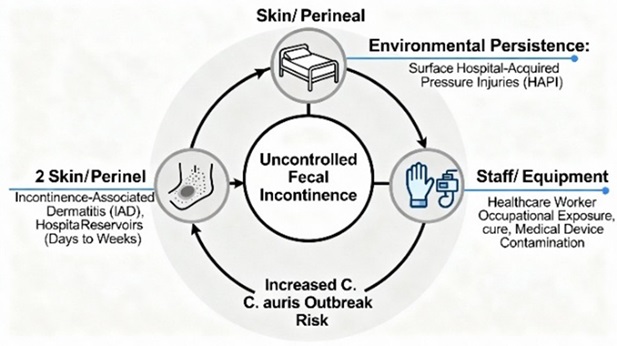 Figure 1: Cascading clinical consequences of inadequate fecal containment in C. auris-colonized patients. The figure illustrates how a single uncontained leakage event propagates through environmental, occupational, and clinical pathways to drive cross-transmission.
View Figure 1
Figure 1: Cascading clinical consequences of inadequate fecal containment in C. auris-colonized patients. The figure illustrates how a single uncontained leakage event propagates through environmental, occupational, and clinical pathways to drive cross-transmission.
View Figure 1
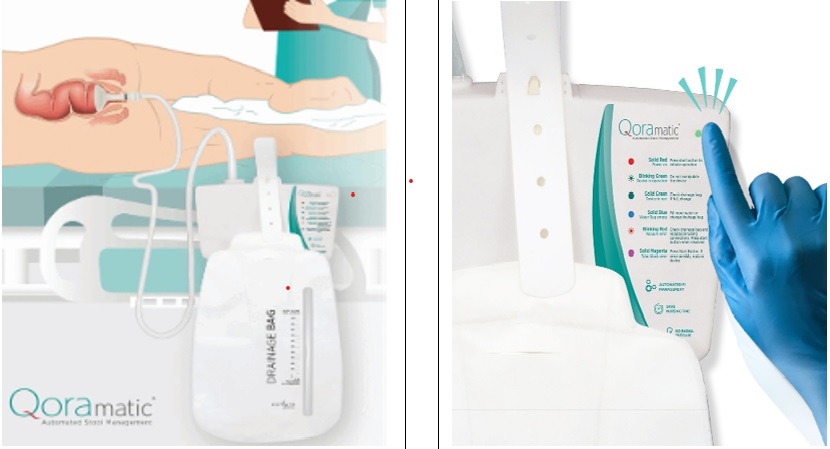 Figure 2: Qoramatic Automated Stool Management system, schematic. Cross-sectional view of the soft silicone receptacle, intermittent negative-pressure suction line, automated irrigation channel, and external collection reservoir.
View Figure 2
Figure 2: Qoramatic Automated Stool Management system, schematic. Cross-sectional view of the soft silicone receptacle, intermittent negative-pressure suction line, automated irrigation channel, and external collection reservoir.
View Figure 2
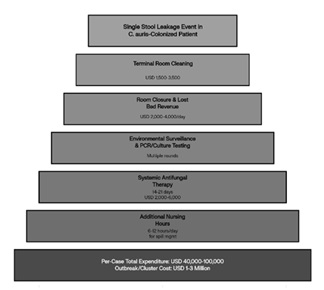 Figure 3: Economic cascade triggered by a single stool leakage event in a C. auris-colonized patient. The figure shows the propagation of cost from the initial event through equipment decontamination, room closure, terminal cleaning, intensified surveillance, and (if cluster develops) facility-wide outbreak control.
View Figure 3
Figure 3: Economic cascade triggered by a single stool leakage event in a C. auris-colonized patient. The figure shows the propagation of cost from the initial event through equipment decontamination, room closure, terminal cleaning, intensified surveillance, and (if cluster develops) facility-wide outbreak control.
View Figure 3
Table 1: Six-step transmission cascade of C. auris from gastrointestinal colonization to outbreak propagation, with associated IPC containment levers. View Table 1
Table 2: Comparative attributes of conventional FI management options versus closed-loop automated stool management. View Table 2
Table 3: Major cost drivers of C. auris transmission events and the role of fecal containment in mitigating downstream expense. View Table 3
Candida auris continues to present a significant infection-prevention challenge owing to its multidrug-resistant profile, environmental resilience, and capacity to spread rapidly in high-acuity care settings. Growing evidence indicates that FI and GI colonization are important — but underrecognized — sources of environmental bioburden and cross-transmission. Conventional methods of FI management (balloon-based rectal catheters, absorbent pads, and diapers) are open systems that often leak, sustaining contamination pathways and undermining containment efforts.
Closed-loop ASM, exemplified by Qoramatic, offers a technically efficient method of mitigating these risks. By creating a continuous, sealed diversion pathway that removes the source of leakage, these systems limit the frequency of high-touch nursing interventions, preserve perineal skin integrity, reduce occupational exposure, and measurably decrease fecal bioburden. When integrated into multimodal IPC bundles, closed-loop ASM strengthens the environmental control strategies essential for C. auris containment.
The integration of closed-loop fecal diversion into facility-level protocols represents a practical, clinically safe, and operationally effective approach to interrupting C. auris transmission pathways. As healthcare systems face increasing threats from multidrug-resistant organisms, particularly in high-acuity and long-term care settings where C. auris burden is most concentrated, advanced fecal containment solutions warrant consideration as a fundamental component of comprehensive infection-prevention programs.
The authors thank clinical colleagues at participating institutions for review of conceptual content, and Consure Medical for access to device specifications and study summaries. No medical writing assistance was used in the preparation of this manuscript.
This work received no specific grant from any funding agency in the public, commercial, or not-for-profit sectors. The authors acted as independent consultants and researchers with no external financial support for the preparation of this review.
Kristin Grimes, Deanna Vargo, and Karen Lou Kennedy-Evans report no financial or non-financial competing interests.
All authors (Kristin Grimes, Deanna Vargo, and Karen Lou Kennedy-Evans) participated in the conception of the topic, deliberated extensively on content and structure, contributed to drafting and revision of successive manuscript iterations, and approved the final version submitted for publication.
Not applicable. This manuscript is a narrative review of published literature. No original human-subjects research was conducted, no patient-identifiable information was collected or recorded, and no new data were generated. References to commercially available, FDA-cleared products (including the Qoramatic Automated Stool Management system) reflect standard clinical practice in accordance with manufacturer instructions for use, approved indications and contraindications, and institutional protocols.
Not applicable.
Not applicable. This is a literature review; no new datasets were generated or analyzed.
This work received no specific grant from any funding agency in the public, commercial, or not-for-profit sectors. The authors acted as independent consultants and researchers with no external financial support for the preparation of this review.
All authors contributed equally to the conception, drafting, critical review, and final approval of this manuscript. All authors approved the final version submitted for publication.