Background: The treatment of plantar fasciitis (PF) is primarily conservative, it includes kinesiotherapy, orthoses, corticosteroid therapy, electrotherapy, but their efficacy remains controversial. An alternative conservative treatment of PF recently more and more frequently used is extracorporeal shockwave therapy (ESWT). In physiotherapy, various ESWT applications, such as focused extracororeal shock wave therapy (FESWT) or radial extracorporeal shockwave therapy (RESWT), are used to treat PF. However, the therapeutic procedures have not yet clearly defined what therapeutic doses effectively eliminate the symptoms of PF.
Aim: The aim of this randomized study was to compare the effects of FESWT with RESWT on foot health status in patients with PF caused by heel spurs.
Material and Methods: The patients were randomly assigned to an intervention groups that received FESWT (n = 30), or to a RESWT (n = 30). The patients in both groups received 5 treatments, 1 per week for 5 weeks. The outcome was foot health status using a foot health status questionnaire (FHSQ).
Results: After the treatments both intervention groups had significantly better the FHSQ scores (P < 0.001). However, the improve of the FHSQ postintervention was statistically greater for the FESWT group compared to the RESWT group.
Conclusions: The doses of FESWT delivered to patients were more effective in improving foot health status. This observation has important implications for physiotherapy practice, suggesting that FESWT should be the primary and preferred method for foot health status in individuals with PF. Nevertheless, basing on the presented results of our own research it should be emphasized that both FESWT and RESWT are safe, effective and easy-to-practice physiotherapy modalities used in the chronic treatment of PF, which is resistant to other physiotherapy methods.
Plantar fascitiis, Heel spurs, Exracorporeal shockwave thepapy, Foot health status
The plantar fasciitis (PF) is a common cause of heel pain in active individuals. The PF plays a crucial role in proper foot biomechanics and consists of three segments extending from the calcaneus. The fascia is essential for supporting the arch and providing shock absorption. Therefore, a gradual degenerative process over time results in inflammation, which increases the risk of PF tearing. The accompanying pain limits physical activity and reduces quality of life [1-4].
Among the main causes of the plantar fasciitis (PF) there are: an inflammation of the Achilles tendon bursitis, fatigue fractures of the calcaneal tuberosity, obesity, running and jumping, work in a standing position, lifting heavy objects, flat feet, rheumatic changes. The multifactorial etiology makes treatment and preventive efforts challenging. The treatment of PF is primarily conservative, it includes kinesiotherapy, orthoses, corticosteroid therapy, electrotherapy, but their efficacy remains controversial [5-15].
An alternative conservative treatment of PF recently more and more frequently used is extracorporeal shockwave therapy (ESWT). The most important is the fact that it is a completely non-invasive method. It has not yet been fully explained how it exactly works, but probably it involves micro destructions - the application of ESWT causes micro breaks in avascular or poorly-vascularized tissues, thus stimulating appropriate revascularization and stem cell growth. Giving the significant reduction of activity limitations and short duration of the treatment, ESWT is also less expensive than a few months of any other traditional conservative treatment [16,17].
In physiotherapy, various ESWT applications, such as focused extracorporeal shockwave therapy (FESWT) or radial shockwave therapy (RESWT), are used to treat PF. However, the therapeutic procedures have not yet clearly defined what therapeutic doses effectively eliminate the symptoms of plantar fasciitis. The question remains: which of the above-mentioned applications is more effective from the perspective of the health expectations of patients suffering from PF caused by heel spurs? Taking under account the lack of that kind researches, the current research team decided to carry out the present study. The team consequently conducted a randomized study to compare the effects of FESWT with RESWT on foot health status in patients with PF caused by heel spurs.
The aim of this randomized study was to compare the effects of FESWT with RESWT on foot health status in patients with PF caused by heel spurs.
This randomized study had a two-arm parallel design with concealed allocation, assessor blinding. The participants were assessed for eligibility by an independent physician not involved in the study. The independent physician interviewed each of the participants, asking them questions connected with their health. All the questions were standardized and prepared by the researchers before the study. The participants were assigned to groups in a 1:1 ratio using a simple-computerized random-number generator. The randomization was achieved by having the participants select 1 of 60 sealed, opaque envelopes enclosing the information about the group allocation. The envelopes were prepared and shuffled by an independent investigator not involved in the study (Figure 1).
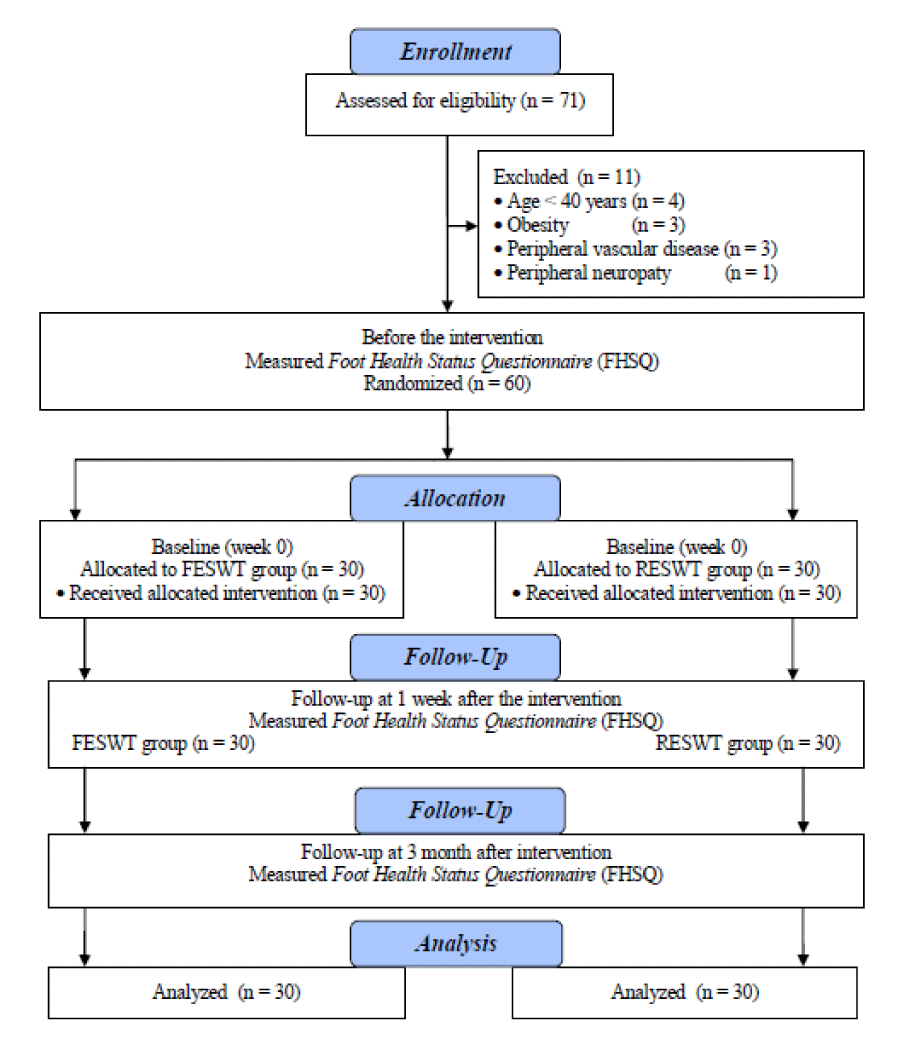 Figure 1: Flow chart diagram.
Abbreviations: FESWT group: Focused Extracorporeal Shockwave Therapy; RESWT: Radial Extracorporeal Shockwave Therapy
View Figure 1
The study was designed with respect for the rules in conducting experimental studies with humans, after approval by the Bioethical Committee at the District Medical Chamber in Cracow, protocol number 6/KBL/OIL/2024 of 29th February. The study’s protocols were consistent with the Helsinki Declaration of 2024. All patients signed the consent forms before the participation in the study (Figure 1).
The research team gave an announcement on the net, new patients came to the Fizjo-Expert Rehabilitation Center for PF. The study was conducted between March 1, 2024, and December 31, 2024, at the Fizjo-Expert Rehabilitation Center in Żywiec, Poland. Seventy one prospective participants were screened for inclusion. Eleven of them were excluded based on the eligibility criteria.
To be included, the patients were required: (1) to be a female or a male; (2) be between 40 and 65 years old; (3) be permanently employed; (4) have been diagnosed with unilateral heel spurs using an X-ray imaging; (5) pain as 3-4 on the Roles and Maudsley scale; (6) unsuccessful of conservative treatment undertaken at least 6 months before the current treatment (NSAIDs, physiotherapy, stretching exercises for the plantar fascia, cortisone injections, orthopedic insoles); (7) had agreed to be treated with FESWT or RESWT.
The prospective participants were excluded if they had: (1) bilateral heel spurs; (2) previous ankle joint surgery; (3) uncontrolled hypertension or cardiovascular, pulmonary diseases; (4) peripheral vascular disease; (5) peripheral neuropathy; (6) mental disorders, e.g., dementia, lack of any verbal communication, failure to understand instructions given by the therapist. Basic statistical data regarding the patients included in the study design showed that the FESWT and RESWT groups were homogeneous and did not differ from each other, which met the requirements of a comparative study in two parallel treatment groups. The baseline characteristics of the participants are shown in table 1.
Table 1: Baseline characteristics. View Table 1
The interventions were provided exactly within the scope of ESWT procedures. The physiotherapist who provided all treatments to both groups and remained blinded as to the outcome measures. All patients in the FESWT and RESWT groups received one treatment weekly for five weeks. No session in either group exceeded 10 minutes. During the intervention, patients did not receive any other physiotherapy treatments. They did not take any painkillers. During FESWT and RESWT treatment the patients did not report any adverse events (worse mood, malaise or increased pain intensity).
In the FESWT group during the first treatment 1000 pulses/cm² were applied, while during the second and third treatments 1500 pulses/cm 2 were applied with a frequency of 6.0 Hz and a surface energy flux density of 0.2 mJ/mm 2 , to a trigger point on the calcaneal tuberosity and the plantar aponeurosis. During the fourth and the fifth treatments 2000 pulses/cm 2 were applied with a frequency of 10.0 Hz and a surface energy flux density of 0.65 mJ/mm² to a trigger point on the calcaneal tuberosity and the plantar aponeurosis. FESWT waves were delivered by the BTL-6000 FSWT FOCUS device, the transmitter had a diameter of 15 mm.
In the RESWT group during the first treatment 1000 pulses/cm² were applied, while during the second and third treatments 1500 pulses/cm 2 were applied with a frequency of 10 Hz, a pressure of 2 bar and a surface energy flux of 0.2 mJ/mm 2 to the trigger point on the calcaneal tuberosity and the plantar aponeurosis. During the fourth and the fifth treatments 2000 pulses/cm 2 were applied at a frequency of 20 Hz, with a pressure of 4 bar and a surface energy flux of 0.3 mJ/mm 2 to a trigger point on the calcaneal tuberosity and the plantar aponeurosis. RESWT waves were delivered by the BTL-6000 RSWT ELITE device, the transmitter had a diameter of 9 mm. None of the patients reported any adverse events (worsened mood, poor well-being, or increased pain) during the FESWT and RESWT treatments.
The measurements were taken at the baseline, 1 week postintervention and 3 months postintervention by FHSQ. The researchers were blinded to the type of the treatment that patients received. To keep the assessors blinded, the patients were reminded before each measurement not to reveal the nature of their treatments.
The FHSQ, wchich comprises 3 sections. Section I has 13 questions that assess 4 health domains concerning feet: Foot Pain, Foot Function, Foot Wear, and General Foot Health. Section II comprises 20 questions that assess patient's health in 4 domains: General Health, Physical Function, Social Capacity and Vitality. Each question allows several answers and these are placed on a Likert-type ordinal scale (words or phrases corresponding to a numeric scale). The descriptors for these scales vary for each domain. The person completing the questionnaire has to choose only one response, whichever is thought to be the most appropriate. Section III collects standard demographic data and variables like; socioeconomic status, co-morbidity, etc. FHSQ data analysis software© (Version 1.03) was used to convert the initial score for each domain to a score between 0 and 100 (worst to best condition) [18].
The study sample size was determined using a predicted effect size of Cohen's d of 0.75, a probability level of 5%, and a desired power level of 80%. It was estimated that a minimum of 30 participants would be needed in each of the two comparison groups. The data were characterized using descriptive statistics as: means, standard deviations, and minimum - maximum. The Shapiro-Wilk test identified the normal or non-normal distribution for all the data. Therefore, parametric and nonparametric statistical tests were used to analyze the results. The between-groups baseline characteristics were analyzed with the Chi-square, Mann-Whitney, Student's t-test. The multiple comparisons within dependent groups were performed using statistical tests including Friedmann's rank ANOVA, Friedmann's rank ANOVA post hoc Dunn's. The level of statistical significance was set at a two-tailed P value of 0.05. To describe the differences in related treatments the effect size (ES) for between-groups differences was calculated using Cohen’s d and classified as small (d > 0.20 and < 0.50), medium (d > 0.50 and < 0.80) and large (d > 0.80). The analysis were performed by a blinded independent statistician according to a prespecified statistical analysis plan on an intention-to-treat basis. Statistica version 12 (StatSoft, Poland) was used for the statistical analysis.
Table 2 compares the changes in FHSQ in the two study groups. In the FESWT group the FHSQ overall improved statistically significantly, as evidenced by the Friedmann's rank ANOVA coefficient of 60.000; P < 0.001. A significant improve in FHSQ by 21.7 points in the FESWT group was found between the 1 measurement before the therapy and the 2 measurement 1 week after the therapy, P = 0.000. A statistically significant improve in FHSQ by 53.5 points in the FESWT group was found between the 1 measurement before the therapy and the 3 measurement, i.e., 3 months after the therapy, P < 0.001. However, between the 2 measurement 1 week after the therapy and the 3 measurement FHSQ improved by 31.8 points, P = 0.000 (Table 2).
Table 2: Comparison of foot health status measured in subsequent studies. View Table 2
In the RESWT group the FHSQ overall improved statistically significantly also, as evidenced by the Friedmann's rank ANOVA coefficient of 58.067; P < 0.001. A significant improve in FHSQ by 21.4 points in the RESWT group was found between the 1 measurement before the therapy and the 2 measurement after the therapy, P = 0.000. Between the 1 measurement before the therapy and the 3 measurement, i.e., 3 months after the therapy, FHSQ improved by 36.2 points P = 0.001. However, between the 2 measurement 1 week after the therapy and the 3 measurement FHSQ improved only by 14.8 points, P = 0.000 (Table 2). The differences between the associated treatments, expressed as Cohen's Effect Size (ES), 3 months after the treatment was very large, reaching 0.8. This means that potentially 92% of the patients in the RESWT group achieved weaker improve FHSQ than the patients treated with FESWT (Table 2).
The effect of ESWT on foot health status in individuals with heel spurs induced PF has been investigated in various comparative studies. Lizis, Hudakowa [19] compared the effectiveness of ESWT with ultrasound therapy (US) in preventing social limitations and the improvement of foot health status in men with a chronic heel spurs. The ESWT group received 1000, 1500, and 2000 pulses during the first, second, and third through fifth treatments respectively (pressure, 2.5 bar; frequency, 8 Hz; energy density, 0.4 mJ/mm 2 ). The patients received 5 ESWT treatments once per week, and each session was completed at a weekly interval. Meanwhile, the US group received continuous ultrasound waves: intensity, 0.8 W/cm 2 ; 100% fill; carrier frequency, 1 MHz. The patients received a series of 10 treatments, 3 times per week. The results of this study provided evidence that patients with PF can obtain significant health benefits to foot care with ESWT.
Shaheen [20] compared low-energy RESWT with placebo eztracorporeal shockwave therapy (P-ESWT) in a randomized, double-blind study. The active treatment group received a total of three RESWT treatments, each with 2,000 pulses, at a power of 0.16 mJ/mm 2 , 2.5 bar, and a frequency of 8 Hz, administered weekly. The P-ESWT group received an identical treatment protocol, but with sham RESWT. Foot function was assessed using the Ankle-Hind Foot Scale (AHFS) and compared the effects between the two groups after 3 and 6 weeks of treatment. Statistically significant differences P = 0.000 were detected between the groups, favoring those treated with RESWT. At the three- and six-week follow-up periods, significant improvements in foot health status were observed in 23.7% and 36.8% of patients treated with RESWT, respectively, compared to 6.6% and 3.8% of those treated with P-ESWT. The study results demonstrated that low-energy RESWT is a safe and effective treatment method for patients who have failed prior conservative treatment for chronic PF. The consequences of using non-invasive therapy, such as RESWT, are characterized by a short recovery period and very few minor transient side effects. Furthermore, patients treated with RESWT can avoid surgery, which is associated with high costs, work absences, and the risk of complications associated with surgery.
Pistrici et al. [21] compared the effectiveness of ESWT and soft tissue mobilization assisted by the Graston GT technique combined with stretching exercises. For this purpose, 69 patients were randomly assigned to three groups: ESWT + stretching exercises (Group 1), GT + stretching exercises (Group 2), and stretching exercises alone (Control Group 3). Randomization was performed in a 1:1:1 ratio. Standard stretching exercises for all groups were performed twice daily for 8 weeks. Group 1 received low-intensity ESWT (3x2000 pulses, at a power of 0.16 mJ/mm 2 ) once weekly. Group 2 received the GT method. Foot function was assessed using the foot function index (FFI) before treatment, after treatment, and at 8 weeks and 6 months postintervention. FFI scores improved after treatment and at follow-up in all groups (P < 0.001), but the effect sizes were larger in both groups than in the control group. Group 2 achieved the largest effect at 6 months. Furthermore, Group 2 demonstrated significantly better improvement in FFI scores compared with the other groups at 6 months of follow-up (P = 0.003). Although ESWT + stretching and GT + stretching treatments had similar effects on foot function at 8 weeks, GT + stretching was found to be most effective in improving foot health status after 6 months of treatment.
The effectiveness of ESWT and custom-made foot orthotics (CFO) in treating PF has also been compared. In a randomized study, Çağlar Okur et al. [22] assigned 83 patients to two groups: one treated with ESWT (Group 1) and the other with CFO (Group 2). In the ESWT group, patients received three ESWT sessions, one session per week, delivering 2000 pulses at a frequency of 12 Hz and a pressure of 2.0 bar. No local anesthetic or analgesic medication was administered before or during the procedure. In the CFO group, custom-fitted orthotics made of thermoplastic polyethylene coated with a soft polypropylene were used to support the longitudinal arch of the foot. Patients were asked to wear these insoles in their shoes for 6 hours per day for at least 4 weeks during the planned treatment period. Due to discomfort reported with the insoles during the first week of use by six patients, the insoles were modified to ensure comfortable use. Both groups were instructed to perform ten repetitions of soleus and gastrocnemius stretching exercises twice daily for one month. All patients were followed up twice weekly in an outpatient clinic. The FHSQ foot health status scores at 4, 12, 24, and 48 weeks after treatment were significantly improved compared with pretreatment scores, P < 0.001. Both groups 1 and 2 achieved significant improvements in these parameters at 4, 12, 24, and 48 weeks compared with their baseline values. The results showed that both ESWT and CFO treatments can be used interchangeably. Neither treatment was superior to the other in improving the function and health status of the foot with PF [22].
Our study conducted a comprehensive assessment of the effects of two types of shockwaves: FESWT and RESWT on foot health status using FHSQ. The results indicate that both FESWT and RESWT applications effectively improved foot health status during the observed study period. However, the doses of FESWT delivered to patients were more effective improving foot health status. This is indicated by the greater therapeutic effects in favor of patients treated with FESWT, which persisted three months after the end of the therapy. This observation has important implications for physiotherapy practice, suggesting that FESWT should be used primarily and primarily for improve foot health status in individuals with PF.
To objectively compare the effectiveness of FESWT and RESWT, uniform inclusion and exclusion criteria were used, ensuring the homogeneity of the study groups, which did not differ from each other before the therapy. This resulted in reliable and comparable results, allowing for a reliable assessment of the effectiveness of the two ESWT applications in the treatment of PF.
It should be noted that the present study design has limitations. Firstly, the relatively small group of subjects recruited for the study. Secondly, the study conducting in one small therapeutic center extended the study's duration, which certainly would not have been the case in a project conducted in multiple centers. Therefore, further multicenter studies with a larger group and a longer timeframe should be undertaken in the future to verify the results presented in this study.
Nevertheless, basing on the presented results of our own research it should be emphasized that both FESWT and RESWT are safe, effective and easy-to-practice physiotherapy modalities used in the chronic treatment of PF, which is resistant to other physiotherapy methods. Therefore, unlike surgical treatment, FESWT and RESWT are noninvasive and can be performed in an outpatient setting, without the need to hospitalize patients after surgical procedures, and therefore, without unnecessarily increasing the total cost of treatment.
The study showed that FESWT and RESWT applications effectively improved foot health status during the observed study period. However, the doses of FESWT delivered to patients were more effective in improving foot health status. This observation has important implications for physiotherapy practice, suggesting that FESWT should be the primary and preferred method for foot function in individuals with PF.
This project did not receive funding from any private, public, or government organizations.
None declared.